
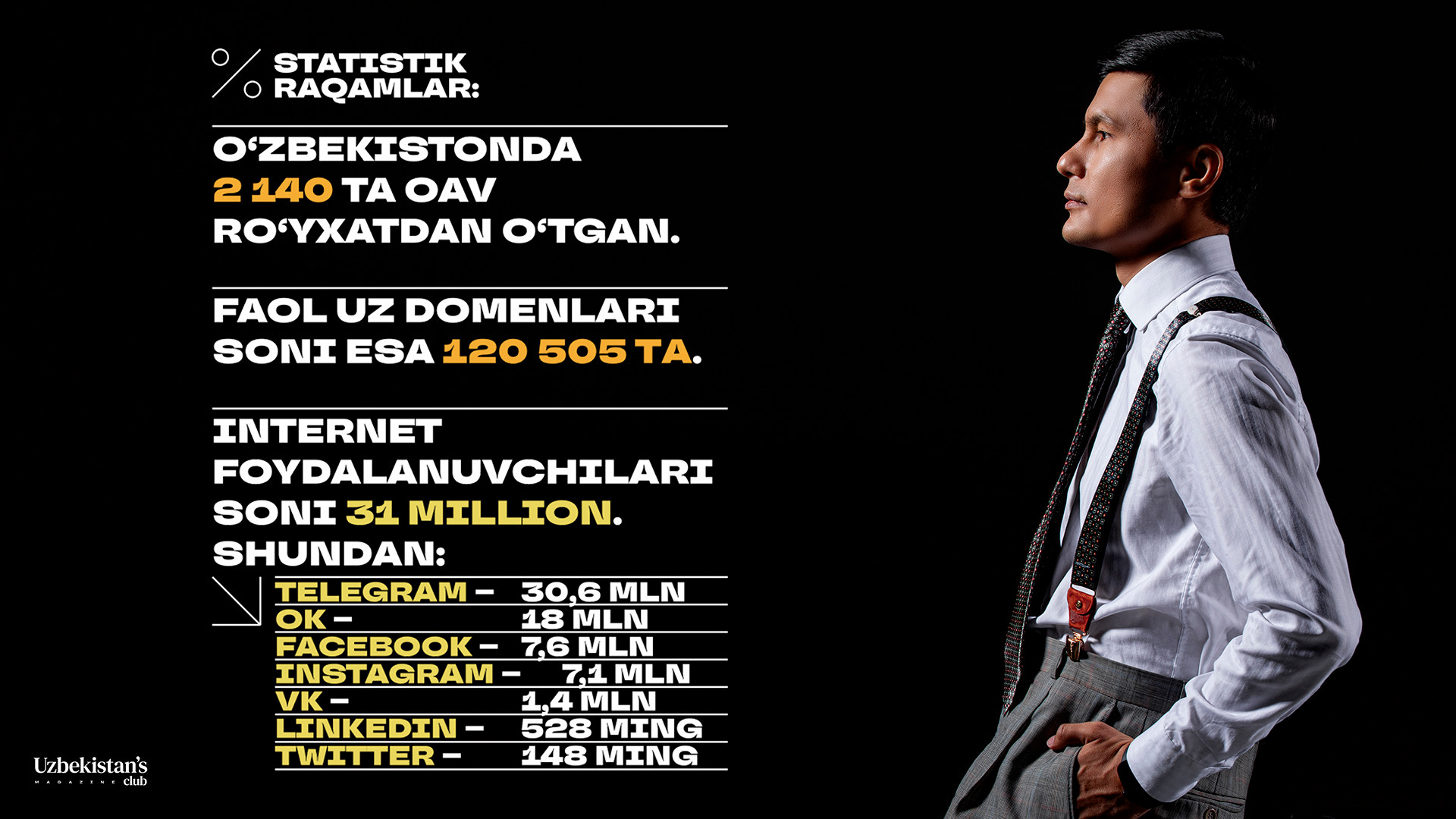
In Uzbekistan, the blogging industry has seen swift development amid the enhancement of the media world. To cite just one example, Uzbekistan has 132 thousand Telegram channels and 21 thousand open groups (chats), totaling 1 billion subscribers. This is the 3rd largest national indicator in the world after Russia and Iran. The number of subscribers of the Top 100 most popular Telegram channels operating in Uzbekistan totals 68 million 874 thousand.
So, who exactly is a blogger? What can be done to ensure quality content and get rid of fake news at a time of increased information flows?
WHO IS A BLOGGER?
Article 3 of the Law of the Republic of Uzbekistan on Informatization provides the following definition: “Blogger is a natural person who posts information, including for discussion by users, of socioeconomic and other nature on his/her freely accessible website and (or) website page in the Internet global information network.
In fact, everyone who falls under this definition is a blogger. This means there are several million bloggers in Uzbekistan, and there is nothing to worry about. Yet many hardly consider themselves a blogger. For example, Uzbekistan’s Minister of Digital Technologies, Sherzod Shermatov, has Facebook, Telegram, and Twitter profiles and regularly posts information. Is he a blogger, then? In accordance with the law, yes! But he barely regards himself as a blogger. There are millions of such examples.
THE DRIVER AND THE BLOGGER
In my opinion, to be considered a blogger, you need to look at the fact that it has become a profession and has earned income. I will explain it in the example of drivers. Who is a legal driver? A person driving a vehicle on the roads. Everyone who drives a car, regardless of profession or position, is a driver. But when it comes to the profession, we consider only people who work as drivers in an organization or earn money as taxi drivers. 10 million people drive in Uzbekistan, then there are 10 million drivers. But our mind accepts only those in professional activity and earn money as drivers.
It is the same with blogging. People who are constantly active, professionally engaged in this work and, perhaps, will receive income from it should be referred to as bloggers. Although, under the law, everyone who maintains a page on a social network is considered a blogger

IF YOU DON’T CRITICIZE, YOU ARE NOT A BLOGGER.
Looking at the issue from the subscribers’ viewpoint is even more interesting. In international practice, bloggers create content on tourism, fashion, culinary, auto, sports, arts, and other entertainment topics, whereas, in Uzbekistan, a person who does not criticize the government and does not write about politics is not usually considered a blogger. True, the situation has lately been changing a little. I believe this is associated with the development of freedom of speech in Uzbekistan. Freedom of speech in this country has experienced a revolution, not an evolutionary development. Western nations have been developing evenly, while we opened up suddenly following a long period of closedness. It’s like storing water in a dam for quite a long time and then releasing it.
People had a grave thirst for political topics, and therefore, there was a great demand for critical bloggers. As I said above, this trend will also calm down over time
STALKING THE BLOGGERS
In Uzbekistan, many believe that bloggers have been growing in number. They need to be regulated, and an organization needs to be set up to create a list of bloggers and issue them certificates. That is a misconception. Registering bloggers or uniting them into one organization will endanger our information space. Because any list eventually leads to a blacklist. This leads to growth in ‘mask’ and fake accounts and anonymous profiles.
Anonymity means no accountability. When reacting on their own behalf, anyone tries to write it as legitimately as possible. However, they know very little about the laws. And when they are anonymous, even if they are geniuses, they are stripped of all responsibility.
In Robert Louis Stevenson’s Strange Case of Dr. Jekyll and Mr. Hyde, Henry Jekyll invents a medicine that turns the taker into a completely different person. Kind and goodnatured by character, the doctor changes his appearance, becomes a savage, and commits murders. That is because people cannot recognize him by his face; he is anonymous, in other words.
That is why the more persecution the bloggers endure, the cloudier the information space, and the more the government suffers.
TOO MUCH OF LIABILITY
In Uzbekistan, the mistakes of journalists and bloggers are considered a serious crime. More specifically, in many articles of the Criminal Code, committing the same act in the mass media or on the Internet is regarded as aggravating.
For example, if you insult someone on a microphone in a stadium with 30 thousand people, that will be a case for administrative liability. If you do so on the Internet, it is a direct aggravating factor. Even if only 50 people saw your post. It makes little sense.
It is wrong to threaten a journalist or blogger with criminal liability for slander and insult. It should be gradually decriminalized and transferred to administrative jurisdiction. If someone’s honor has been degraded, it generally belongs to civil jurisdiction. Let him collect a civil penalty for moral damage. There is little need for the state to intervene.
In many countries, defamation or insult does not cause criminal liability. In our country, regrettably, it remains one of the weapons of intimidation and persecution.