
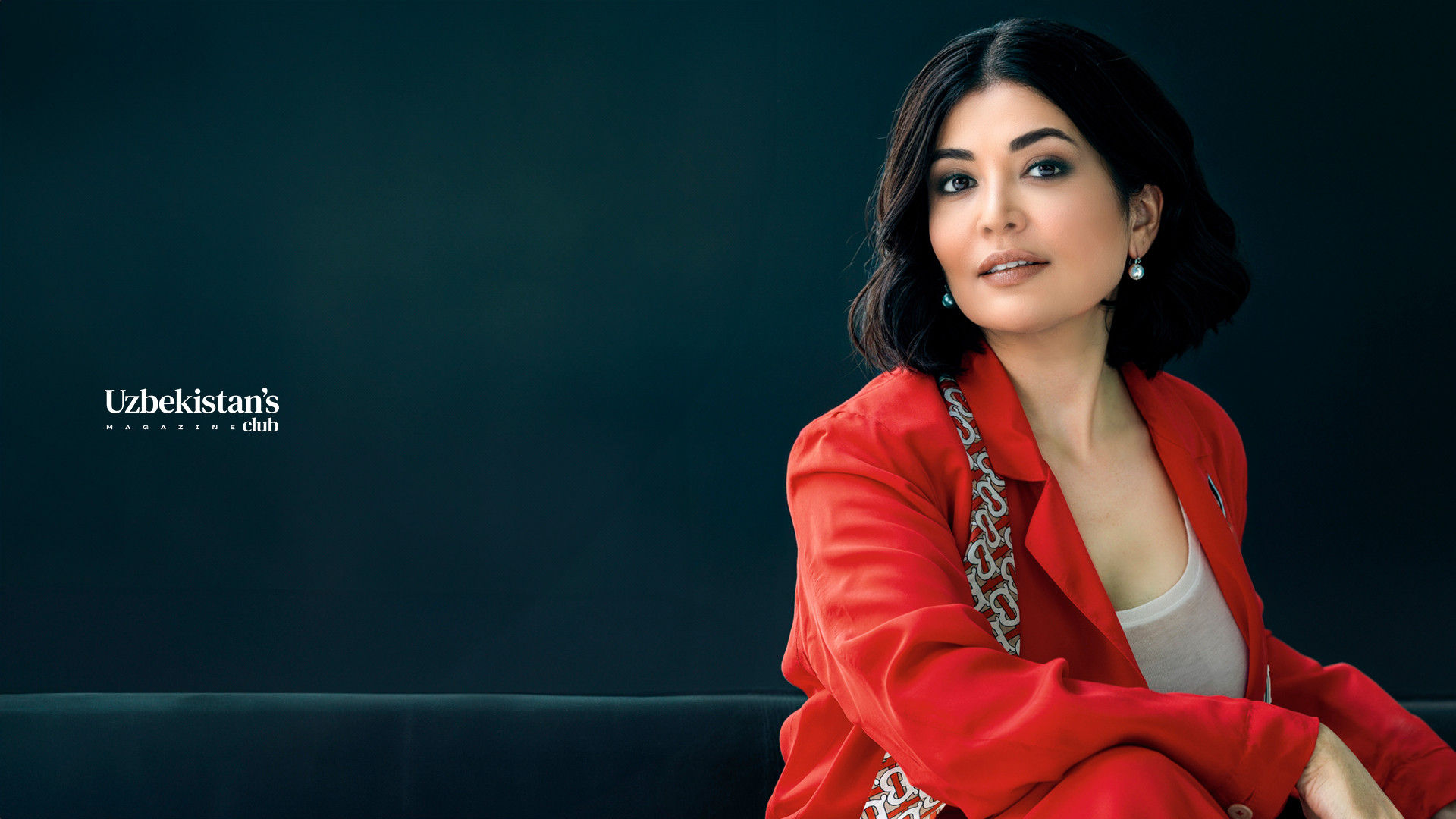
Saodat Tursunova is the author of the project Uzbechka (Domodedovo Airport, Moscow, 2006). Winner of the PIR 2009 competition “Restaurant of the 21st Century” in the nomination “Original Concept and Ideal Embodiment” for the concept of the restaurant Chibi.
Ms. Tursunova wields experience in business management for more than 20 years in three countries. Her track record includes success stories in crisis management of enterprises, in launching projects from scratch. She is owner of the company Sati by Saodat Hospitality, which includes Besar u Lali in Dubai and Farш and Sora in Tashkent.
Owner and founder of Farш in Tashkent. The projects Uzbechka, Shara-Bara,
Ogni Tashkenta, Farш are successfully functioning to this day.
- Tell me please, did you end up in the restaurant business by accident or did you dream about it?
- Completely by accident. It so happened that my family and I moved to Moscow, where a close friend of mine and I would organize large-scale festivals of Uzbekistan, silk festivals. I found it very interesting, but it was not a very effective time spending. After some time, I was offered the management of a fashion store in Moscow. As it turned out, I can very quickly delve into the topic of business, regardless of the sphere. With the outlet store there was a good result: revenues grew threefold within a short peri- od of time, and we decided to open a second branch. By now my colleague restaurateur and at that time the editor of the Moscow-based magazine Restaurateur, Yekaterina Drazdova suggested that I tell about the Uzbek bread, and Dan Lepard, an Australian baker, culinary writer, photographer, TV presenter and celeb chef, came to my home. During the shoot I talked about how my mother used to make bread and bake it, explaining the intricacies of Uzbek bread baking, what the dough should be like and the role of love in this process. It turned out to be an interesting material for a magazine with a photo session.
Sometime afterwards, that event led me to meet an owner of a restaurant who was having difficulties in management. Word for word, I took on this project. At that time, the enterprise was unprofitable – there were no risks in entrusting it to a newcomer. I started the project in two capacities: as a manager and as a chef. I changed the concept of the restaurant, and its name – Ethno – allowed making changes to the decor, and if previously the restaurant had an Indian cuisine specialization, I turned it into an oriental one with different cuisines, including Uzbek, without spending a penny. It came to be such an interesting mix that it soon became very popular.
I had agreed to this offer for one important reason. The condition of the restaurant owners was in the amount of payment: they wanted to pay me thrice the fewer amounts than a man in the same position. When I asked why, the answer was short: because I am a woman, and that I cannot do better than men. This hurt me to the end! I suggested them to come up with phenomenal results, and, if this is the case, I would get the full pay as a man would in the same position. And that’s what we agreed on. I had to work around the clock, and now recall how I didn’t get enough sleep; actually, there were days when I didn’t sleep for 24 hours! Literally in a month, the restaurant secured that very extraordinary result – a several-fold increase in profits. That is, in a month I had to delve into the intricacies of a business completely new for me, wedding two leading roles in the process, change the concept, unite the team and provide for an outcome measurable in numbers. It is worth noting that the staff had already been working in the restaurant for a while before I came, and thus at first I had a tough time. So I had to develop a commanding voice – the work immediately went faster. From a restaurant that was almost always empty, looking for banquets, it turned, within a short time span, into a popular place where we started to look for tables to add to the hall. In six months, revenues grew almost tenfold! In the first month, they paid me like they would for a man – three times the amount they had promised on my candidacy.
- What was the name of the first restaurant of yours?
- My first project, created in accordance with my concept, was the restaurant Uzbechka in 2006, located at Moscow Domodedovo Airport, com- missioned by the company Kofemania. It was the only restaurant with open fires at the airport at that time. We met with Igor Viktorovich Zhuravlev and he told me about the idea of his project, and he drew sketches, and I watched and tried to understand how the Almighty can endow human beings with ideas and inspiration. The thing is that everything that Igor told me and drew was drawn by me 1.5 years ago. And I suggested meeting him specifically to tell him about this idea, but the reason for the meeting was to consult on a completely different project. A dream not only inspires, but also, like
a magnet, attracts people to each other, uniting them with an idea that must be realized.
I came up with a name for the restaurant, yet Igor jokingly suggested calling it by my name, but I said, “Uzbechka, and that’s it!” At the very first meeting, I showed my sketches to Igor, and he asked in bewilderment how I managed to draw so quickly? I told him how I had the idea of the restaurant long before our conversation and the files were made on the computer. Together, we realized an important thing: we were led to the creation and implementation of this project by each of our own higher powers. Thus, in 9 months we made one of my most lovely projects, existing to this day, and now it has moved to Sheremetyevo Airport. I did this project with the architect Alexey Nazarov, of whom I am very proud and grateful to. The scheme was competent and then I predicted a boom and popularity of Uzbek cuisine – in 2006. And so it happened.
The most difficult moment of work on this venture was to build the ventilation correctly. Although Zhuravlev offered me to invite specialists from abroad, I was looking for specialists to whom I could explain my idea in all its intricacies, since it was important for me to speak my language. I am an engineer by education, and we came up with the option that became operational. I remember how I explained the principle of the tandoor, the fireplace, and the ventilation had to ensure the safety of the strategic facility, passing through seven spans of the existing airport. Because the area of the establishment occupied just 200 square meters, we had to very wisely plan every centimeter. It was a phenomenal organizational, engineering, conceptual work that was destined to be successful. A large share of the success story is the work of Rishtan craftsmen, who were able to fit every tile, every jug and every detail to perfection in accordance with our drawings, all my ideas on paper fell into place, every centimeter, every color matched each other.
Name your favorite project. Reasons?
Tough question. You confuse me. Every project I come into contact with, I focus on it, and I love it unconditionally. I once created a Japanese restaurant called Chibi (chibi is a style of drawing anime characters with a small body and a large head, almost proportionate to it; usually, the height is canonically 3-5 head heights, which corresponds to children’s proportions), for which we received the award “For the Best Concept” in 2009 in Moscow. For this undertaking it was important to deeply immerse ourselves in the Japanese theme, study their culture, traditions, subtleties of life, hospitality. For me, Japan is like a space mission
– everything is incredibly exciting. In this scheme, the most difficult aspect was to develop a corporate style. I wanted to set the tone of the project starting with the corporate style, in the end the restaurant was already functioning to the full, while we drew the logo for 9 months! I expected a Japanese representation, not a parody, but an individual, exclusive one. In order to be able to find what suits us, it is vital to be empathetic, to have an open heart and consciousness, to be able to feel and then create what the guest will like. Each venture requires your love, immersion: you fall in love, work long and painstakingly and, as a result of this love, a good project is born, like your child. I really hope to have Chibi in Tashkent somehow renewed.
- How do you choose a project for your next restaurant?
What do you focus on?
- It’s different every time. For example, when we started the Ogni Tashkenta project, they showed me the premises; I started studying global and metropolitan trends, as well as the specific location, and calculating the economics. By the way, even just walking around the city, I always scan the economics: rental rates, which organizations rent more premises, and all this gives me specifics on a given situation. Building on this, I start thinking: is such a story reason- able for this place, at this specific intersection of time. Sometimes it’s the other way around. There is information that a specific cuisine is popular, and you look for premises for it. Some- times people come up with an offer, a specific amount of possibilities, and if the idea resonates with me, as we say in our country, “jiz etdi” (the stars shine properly), then I start working on this idea before agreeing to the project. A certain ‘reference point’ is essential. Sometimes this point can be my night dream, for example, which inspires me to come up with the idea for the venture.
- What project are you currently working on?
- In Tashkent, these are two projects: the Farш restaurant, which has been operating for about two years, and the Sora restaurant, which is in the pre-launch stage. There are also two projects in Dubai: one is being built on Palm Jumeirah, and the second on Bluewaters Island. One is a Spanish restaurant, which is under the attention of the Dubai mayor’s office, and the second is an Uzbek restaurant – both are luxurious and gorgeous. The appearance of the Uzbek one is absolutely unique, no one has ever presented an Uzbek restaurant like this before; thus I offer my vision. I am sure that both projects will be successful.
- Were there any funny, anecdotal cases where you had to ‘sort out’ situations with project customers on yourself?
- I’ll tell you a story about how I ended up in Dubai. At one of the business meetings in Tashkent, a friend from Dubai flew in and told me about the difficulties in launching an Uzbek restaurant at EXPO, and that they really needed the help of a professional. Since the guys were close friends of mine, I could not refuse them, and literally in 2 days I gathered specialists from Moscow, Tashkent and Almaty and came to ‘save’ the Uzbek pavilion. In three weeks, we completely redesigned the restaurant, which had been prepared for three years before
us. During the entire period of my work in various projects, I never went out into the hall. I watched the entire process on the screens in my office. The restaurant Lali, which we made for the EXPO exhibition, became the place where I had to go out into the hall.
Since we brought our own chefs, it was easy to form a strong kitchen team, and we recruited local staff for the dining room. I didn’t even have the time to get to know them well, but there was already a huge flow of visitors, an incredible influx of people every day, not to mention the fact that many high-ranking guests came to us, you understand that this is a big responsibility for a restaurant. Those included government ministers, sheikhs, and other very important people.
There was a case when the head of EXPO came to us for six minutes for an overview visit, and ended up staying with us for an hour and a half, and with him was a large retinue of accompanying persons. This was the day of my debut – I had to put on a silk robe and go out into the hall. To be honest, we were not ready to serve a large number of people at once; how- ever, I am happy that we coped with that sudden mission. My team and I improvised and for the first time I had to go out to an honorable guest as a hospitable hostess. I was embarrassed, as I have no experience as a waiter or hall administrator, but the sheikh was incredibly attentive to me and kindly noted all the strengths of the project, the dishes and the team. Journal- ists took pictures of us; I smiled and kept up the conversation, simultaneously observing the processes of receiving the delegation. Our photo got into the chronicles of Dubai EXPO, and after this noisy visit, the hall was full of guests in white kanduri every day.
- As the saying goes, happiness is a highly paid hobby. Is that about you?
- Good question! My dad once told me, “Never chase money. Instead, chase work, and money will chase you!” I understand it this way: it is essential to bring your skills to a high level by honing and improving them – you become a master of your work – and abundance will flow by itself! This is a rather wise truth that has settled in me and has become my conviction. It is also very important how we are raised in the family – I grew up in a family of educated people with good taste, I was lucky in this regard. For a long time, I did not understand whether I knew how to manage a business, how to build, how to cook, because I did not study this specifically. Now
I know the answer to this question for sure: it is not only my upbringing, and many of these things owe to genes. Whenever I lead a project, I am completely and utterly captivated by the topic. The soul must burn – it is the fire in the heart, the energy that gives us the opportunity to achieve all the goals set. Two aspects: when you are talented, when you have the intelligence to work on the topic, and when you are a mature person, you are able to withstand the load to achieve success. During the time of project management, I realized a vital truism for myself: at the moment of implementation of any project, you are under enormous pressure, and you must endure it, simultaneously not losing inspiration to create. It is your métier of spirit, faith in the idea of the project, its mission – all this gives strength to go to the set goal. Your eyes should shine, you should look beautiful, hold an important meeting, build, cook – during the day you must prove yourself in all the roles available to you as a person, and with such a load do not lose the smile on your face, maintain cheerfulness and carry inside yourself every day of your happiness from doing your favorite job. Important conditions when choosing a project: I should feel inspired by it, and I should also be interested in a business partner – a like-minded person who shares values and life principles, because the basis of everything I do is my heart! It is this feeling of happiness from what I do that helps me achieve such results; secure financial success for me and my partners.