
- We will all be well rid of primitive perceptions about Uzbekistanis.
- Avloni’s warning a hundred years ago is still relevant: education is a matter of life and death.
- Strong people with intellectual clout constitute the nation’s great asset.
- Every Uzbekistani can make a change, even if it is small.
- Taking pride by claiming “I am an Uzbek, a bek for myself” will lead to national degeneration.
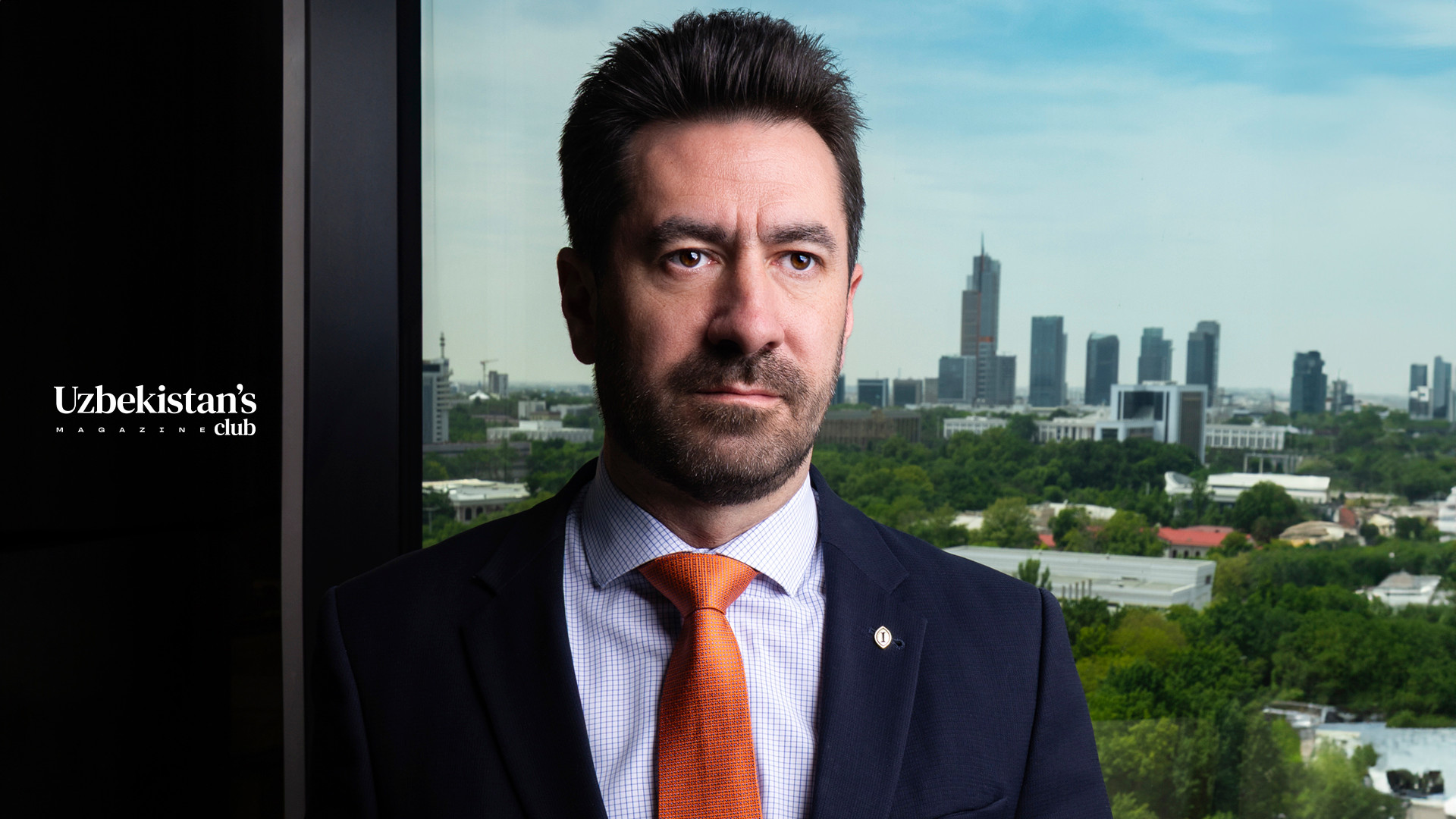
Interview day. 6.30 pm. I was warmly greeted on the campus of the University of Journalism and Mass Communications of Uzbekistan; the staff offered me a tour of the administrative office saying that the rector was holding a meeting.
An official who has been working here since the reconstruction of an old college in the neighborhood and a kindergarten [territories and buildings of the two served as foundation for a new university – trans.] went to introduce me to a small museum. He noted that in the first year the institution commenced, applications and admission examinations were organized at another university in Tashkent. Back in 2018, when Sherzodkhon Kudratkhuja worked as head of department at Jurfak [Journalism Faculty] or the ‘16th faculty’ of the National University, the President of the country initiated the idea of establishing a journalism university. It admitted 119 students in the first year. Then, as the official told me with pride, the University of Journalism and Mass Communications of Uzbekistan went on to house blocks totaling 25 stories as well as a library of its own, TV and radio studios, media center, state-of-the-art educational blocks and dorms, almost 4,000 students, 350 faculty members. It has come to be a promising major university with 19 fields of journalism and disciplines such as political science, psychology, and sociology.
I entered the rector’s room when the meeting was over and the professors working on new textbooks were leaving. But Sherzodkhon Kudratkhuja called them to the books piled at the other end of his desk:
“I am sending [these books – trans.] to School 260 in our neck of the woods. Would it be enough if I give a copy of them? No, I’d better give two copies of each of these texts. “The Fourth Industrial Revolution”, “Animal Farm”, “The Latte Factor”... Let me see what is there… Wow, “How did Georgia succeed?”, “Don’t be scared”, “Scorpion from the Altar”... They say they don’t have these books in the school library..."
18:40. I got welcomed by the rector with honors. Tea and sweets are part and parcel of such premises. The honorable rector wanted me to try some tandoori meat that someone had brought from southern regions of the country. With such hospitality we started our conversation by talking about the notion of Uzbekistani, our national identity, our distinct features...
At the dawn of independence, once we started to make out of our identity, when we said ‘Uzbekistan’, we thought of lagans (Uzbek folk-style big plates) and chapans (national robes), red suzanis or art restaurants with muddy walls. I have acquaintances who do not know a single word of Uzbek, and they used to wear our pink and yellow adras clothes on holidays. Our shared values as a nation are not just our food, clothes, music and dance. The fact that people get skullcap on their head during some events barely makes them Uzbek or Uzbekistani.
When it comes to the notion of Uzbekistani, especially abroad, we have facilitated the formation of such a view based on our outward images, but this is a very primitive perception and we need to change it.
For me, Uzbekistani is a vast concept. That is a human capital that is being formed and developing in us. Uzbekistanis are a large class that includes not only Uzbeks, but all our citizens who consider themselves to be part of our country as well as our expats abroad. It is important for representatives of the people of Uzbekistan to know and introduce themselves as “I am from Uzbekistan”, “I am Uzbekistani”, regardless of what region or district they were born and grew up in.
- What can unite the people of such a large nation like Uzbekistan?
Pilaf unites all Uzbekistanis. In other words, they get united by two things: wedding or mourning pilaf. I don’t look at it positively either. It is not enough. As our great Jadidist statesman Alikhantura Soghuni said, “If Uzbeks gathered together for other things as they do for pilaf, there would not be a more powerful nation in the world”. Thus, we need to unite to address our problems, say, by contribution to the advancement of science and education, not by food and drink, chaykhana-style parties.
– How? Can you provide examples?
- For example, there are 10,750 schools in Uzbekistan. The state provides them with basic conditions, 5-6 trillion soums are spent on paying teachers and employees. But it is impossible to deliver smart boards, the latest books or other modern conveniences to so many schools at once. Uzbekistanis at home and abroad should unite their efforts on this issue.
Today, wherever you look around the world, there is a battle for talent. Take Indians and Chinese. In my opinion, a big competition between them has yet to come in the coming years. Why are Indians as mature specialists ascending to top jobs in the UN and other prominent international institutions and managing positions in giant multinational corporations across the world? Why are there Chinatowns in the capitals and cities of every advanced country? Why is the iPhone made in China? All this goes back to the fact that if there is a large population, both its labor-capable part and its unique talents, probably one in a million people, will naturally be more than those of other countries. In accordance with the probability theory, it is more likely that more population produces more geniuses and unique talents.
English is an official language in India, many people in that country are fluent in English and aspire to opportunities around the world. Young people from India or China are flexible, able to dynamically and quickly absorb lifestyle novelties. And they have many examples worthy of inspiration and aspiration.
- Where are we on this path and what should we do?
- We have a great opportunity, a demographic dividend, to make a good use of. We are 37 million these days. New talents are likely there to emerge. The provision of quality healthcare and education for our population is going well. If our young people are well educated, they can make a tremendous contribution to socioeconomic development.
Sometimes, unfortunately, the word Uzbekistani has for the most part come to mean labor migrants who take up the jobs that the host peoples abroad do not want to do. To be sure, this is a result of a weak economy that used to be the case in our country for many years. Many nations have passed through this stage. But the new generation of Uzbekistanis should set big goals for themselves and take a well-deserved place in the world. I liken it to Maslow’s pyramid: we fill our bellies first, then we think about other things. I believe we have reached this new stage. As we develop education, we must bolster universal human values and education in the family, school, and society.
Another example: look at the history of Turkish immigrants in Germany. Having suffered defeat in the war and lost its influence, Germany received millions of migrants from Turkey. They worked in unskilled jobs, but across years, their children have come to own large businesses and be mature professionals in diverse fields. German Turks are even elected to the Bundestag [German national parliament – ed.].
- You say that our youth should set big goals. What should be the common objective and idea for Uzbekistanis?
- Look at the splendid national idea the Turks have: Ne mutlu Türk’üm diyene! [What a happy person who says I am a Turk – ed.]. Or what the French say, “Liberté, Égalité, Fraternité”, or the American Dream in the U.S., for that matter.
I would like the Uzbekistanis to think that they can make a good input into the development of Uzbekistan, even if it is small, and not behave like they are just a consumer in a big country or that they can’t have any impact on decisions. Realizing this, it is worth living in pursuit of such a high goal.
For that, we need to know Uzbekistan, its principal pressing issues, its geography, history and speak Uzbek well. After all, how can you love your nation if you have little knowledge about it, and how can you contribute to its development if you don’t love it?
Regrettable as it is, children growing up in our country do not know the Uzbek language well, let alone the kids of Uzbekistanis who have gone abroad. After all, language is a unique part of a nation that distinguishes it from others. Some compatriots love to boast that their children speak three languages, they send their sons and daughters to foreign language schools, but who do not know a single word in Uzbek.
Born in Uzbekistan, many young people, unfortunately, do not know much about this land. No clue about, say, what kind of problem the double locked country is for us, or how many percent of Uzbekistan’s territory is attributed to Andijan and how many people live there.
(19:20. Suggesting that we have talked enough, I thanked the rector for the insightful conversation and the interesting information).
- What else would you like to talk about that I failed to ask?
- Don’t be afraid to write this down: I don’t like this phrase being misused like this. Telling everyone that as an Uzbek, you are bek [sovereign – trans.] for yourself [uz – trans.], that is, thinking only of yourself is selfish and hypocritical. Especially after reaching a certain level in society or after gaining some material wealth, it is wrong to live with such a notion.
We will all pass away, and all that will remain of us is the good deeds we did and the knowledge we acquired and shared. So many rich people have passed away in the world, but we don’t remember them! We will remember Imam al-Bukhari, Ibn Sina, Khorezmi even after a thousand years have passed. They did not live for themselves, thinking that they are beks for themselves. Did Imam al-Bukhari, for instance, collect so many hadiths for himself? Wasn’t the Noble Prophet (p.b.u.h.) an example of good behavior for all Muslims and showed them how to live? After all, he lived in a small hut, slept on a simple mat, and distributed the blessings that came to their home to the needy people. His two shovels did not see a Jacuzzi, he was short of food for weeks, and used to go to bed with his stomach tied with rocks to make it feel full. Living in Arabia, he performed Hajj just once and Umrah four times. Today we know people who undertake Umrah 10-15 times; they don’t check their child’s diary of marks, while the school and polyclinic in their neighborhood are in the poorest condition...
“Iqra”, “Iqra”, “Iqra” (Read), tells us Allah Almighty in the Holy Qur’an. Learning is a duty for us. There is a lot to be said for acquiring knowledge, the solution to most of our problems lies in reading and learning, and our development as a nation directly depends on magnifying our intellectual prowess.